This is not an official website of Ranthambore Tiger Reserve. This is a registered private travel agency( GTI Travels Pvt. Ltd.) which organizes hotel, safari and tour package bookings in Ranthambore National Park.

This is not an official website of Ranthambore Tiger Reserve. This is a registered private travel agency which organizes hotel, safari and tour package bookings in Ranthambore National Park.
The Ranthambore National Park, located in Sawai Madhopur — one of the historical districts of Rajasthan — holds a prominent place in wildlife tourism worldwide. Nestled lazily in the foothills of the magnificent hilly terrain of Aravali and Vindhya ranges, the park is a fantastic gateway to an adventure-filled holiday amidst raw nature along with an unforgettable sighting of exotic wild animals. Witnessing such rich and exceptional wildlife and spending time in the tranquil ambiance of a forest is like a tryst with the might of Nature. A rendezvous with the most brutal and beautiful predator our Nature has ever produced, the Royal Bengal Tiger, is a once-in-a-lifetime experience.
The Ranthambore National Park wraps around 392 sq km in which 282 sq km is a core area and the rest is buffer area. The tiger reserve zone of the Ranthambore forest which was constituted in 1973 initially spread in around 334 sq km area which further extended in 1991 to the adjacent sanctuaries of Sawai Man Singh Sanctuary and Keladevi Sanctuary, currently having 1,334 sq km area as a tiger reserve. In the year 1955, this renowned forest was constituted as the Sawai Madhopur Game Sanctuary with the status of a wildlife sanctuary and included in Project Tiger, a Government of India initiative to save endangered tiger species, in 1973. The Ranthambore tiger reserve forest was given National Park status in 1980 and the adjacent forests were named as the Sawai Man Singh Sanctuary and Keladevi Sanctuary in 1984. Sprinkled with a few of the ultimate ancient structures, the Ranthambore National Park is the visual amalgamation of the prehistoric era and the modern era amidst the beauty of the exotic landscape.
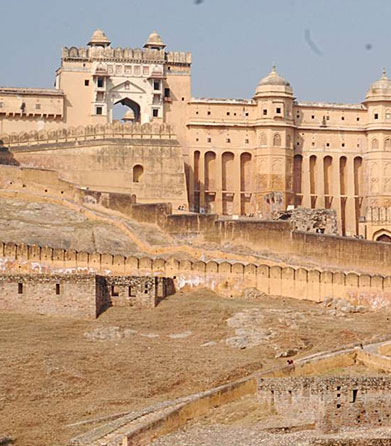
The numerous lakes, water channels and water holes that are scattered in the park not only offer tourists an amazing sight but also nourish the flora and fauna of the region. The mighty Ranthambore Fort from which the forest drew its name is located on the hill and leans over the Ranthambore Park overlooking the entire forest.
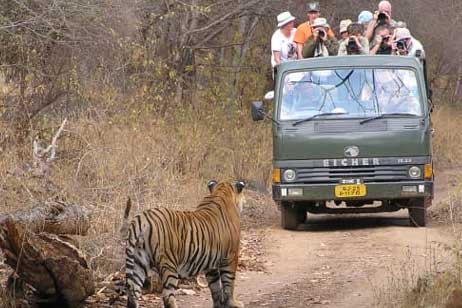
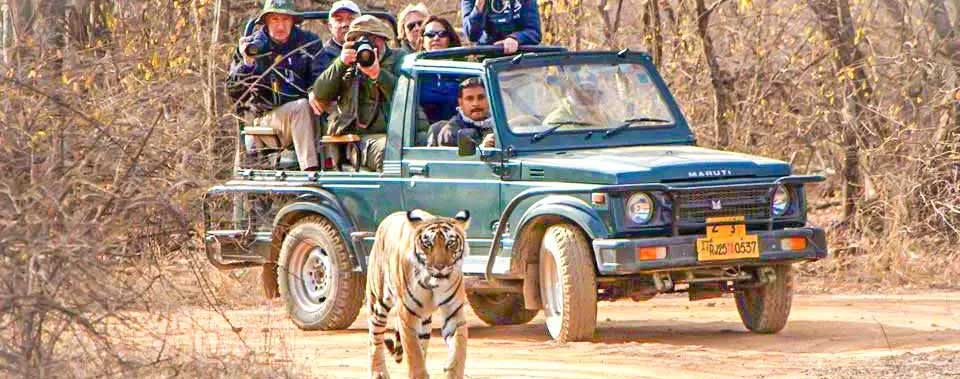
The Ranthambore National Park is highly popular among wildlife tourists due to the forest safari offered by the park administration to explore the rich flora and fauna while being a part of it. The majestic tigers can be seen in the daytime as they don't get scared by the presence of jeeps and humans in their natural habitat. So, the experience of witnessing fearless tigers is indeed extraordinary for tourists — this is how a real wild tiger actually behaves.
The Ranthambore National Park is undoubtedly a dreamland for any wildlife photographer and enthusiast. The park remains open all round the year except July to September as it remains closed for three months due to the monsoon season.
This park is a wonderful destination for wildlife lovers as it provides an amazing opportunity to explore the best sights of jungle inhabitants. To make the tour to Ranthambore a pleasant experience, a range of accommodations from 5-star hotels and resorts to economical hotels are available nearby the park offering an aesthetic stay.
Ranthambore National Park spans a plateau that gets very little rainfall around the year and due to which, the forest has not-so-dense greenery except near the water bodies. Also, the Ranthambore forest is a dry deciduous type of forest with undersized trees which shed their leaves in the summer season. Such ecological terrain makes this tiger reserve zone best for the safari tour as it is easier to spot a tiger here. Furthermore, the Ranthambore Tiger Reserve has 10 tourism zones with large networks of forest tracks used for safari tours that are motorable for most of the year. The good network of safari tracks provides a good opportunity of tracking a tiger or other wild animals from the jeep or canter. All these aspects offer excellent wildlife viewing experience which you will not find in many other wildlife reserve forests of the country.
The visibility is quite good in the forest due to the presence of small shrubby trees and thin patches of tall grasses, and one can spot a tiger even from a long distance by using binoculars. Besides these, the tigers in the Ranthambore forest are diurnal — they roam or hunt in the daytime unlike tigers in other places which are nocturnal. Due to this, many incidents are reported by safari tourists where they saw the complete hunting process of a tiger. The best thing about the Ranthambore tigers is that they are not shy of safari jeeps and tourists. They fearlessly pass through or stay seated in rest just beside the safari jeep providing ample time to view this majestic predator to your heart's content.

Like every other place, Ranthambore also faces three main seasons — Summer, Winter and Monsoon. Summer spreads from the end of March to the end of June. During these months, the day temperature reaches 40°C and the night temperature remains around 30°C. In May and June, the temperature even crosses 45°C making the day very hot. The wind gets very dry and the sun piercingly hot. During this season, tigers and other large predators spend their time in the valleys or in the dense area of the forest or near the water bodies.
After summer ends, monsoon starts from July and stays up to September. During these months the park remains closed for tourist activities. Winter starts from November and stays till the end of February. During this time, the day temperature lingers around 20°C, but the night temperature drops to 10°C or even lesser at 2°C between late December and early January. There are also chances of dense fog in the early morning and late night during peak winter.
When it comes to the best time to visit Ranthambore National Park, tourist visits increase from the start of November to mid-December and from mid-January up to mid-April. During these periods, the climate is pleasant and touring can be hassle-free and fun. Moreover, the forest is bustling with lush greenery and the lakes are filled with aquatic flowers offering a mesmerizing view. However, if you can handle the summer heat of May and June you can visit during these months too — carry full-sleeved cotton dresses, a hat, sunglasses and high SPF sunscreen.
Timeline:
This is a Registered Private Travel Agency under the name of “GTI TRAVELS PRIVATE LIMITED” which organizes Ranthambore Tour Packages & Jeep Safari Packages.
Book Safari Online